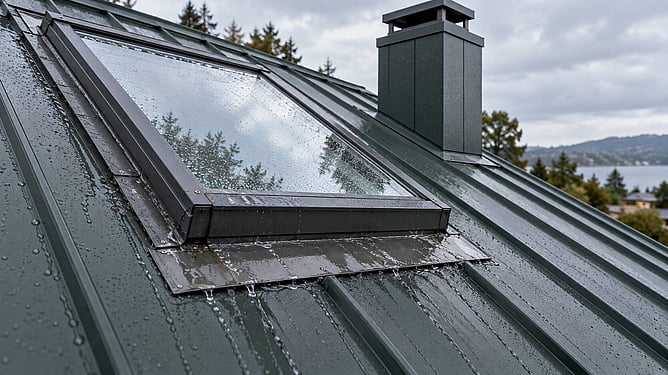
Rain coming in around a chimney or skylight does not necessarily mean the chimney or skylight itself has failed. The junction where either feature meets the roof is one of the more vulnerable parts of a roofing system, and damaged, poorly fitted or deteriorated flashing can allow water to get underneath the roofing before it becomes visible inside the home.
That is why the point where you see a drip, stain or damp patch is not always the point where the water is getting in. Moisture can enter through a small defect around a roof penetration and travel along roofing materials, underlay or framing before appearing somewhere else internally.
When we are looking at a potential roofing replacement or repair, we investigate any leaks around chimneys and skylights, and are therefore looking at more than the obvious wet area. The goal is to find the actual water-entry point and understand which part of the roofing detail has failed before deciding how it should be repaired.
Why Chimneys and Skylights Are Common Places for Roof Leaks
Water normally has a relatively straightforward path down a roof. It falls onto the roofing surface, travels towards the lower edge and is directed into the guttering system.
Chimneys, skylights, flues, vents and other penetrations interrupt that continuous surface, which means extra detailing is needed to keep water moving in the right direction.
Flashing is an important part of that detailing. It is shaped and positioned around vulnerable junctions to direct rainwater back onto the exterior roofing surface instead of allowing it to travel beneath the roof covering.
New Zealand Building Code guidance under Clause E2 focuses on preventing external moisture from causing undue dampness or damage. The current E2/AS1 Acceptable Solution includes requirements for flashings used around junctions and penetrations, as well as requirements around material suitability, exposure and compatibility.
How Roof Flashing Directs Water Around a Penetration
Flashing around a chimney or skylight is not simply a strip of metal covering a gap. The entire detail needs to manage water coming down the roof and direct it safely around the penetration.
Depending on the roof type and penetration, this can involve flashing at the upper side, lower side and edges, together with correctly formed laps and upstands. Roof pitch, the location of the penetration, the amount of water flowing towards it and the roofing material all affect how that detail needs to work.
New Zealand metal roofing guidance specifically identifies chimneys and roof lights as roof penetrations and notes that penetration design depends on factors including roof pitch, roof type, position, shape and catchment area.
Why a Small Flashing Defect Can Cause a Bigger Internal Leak
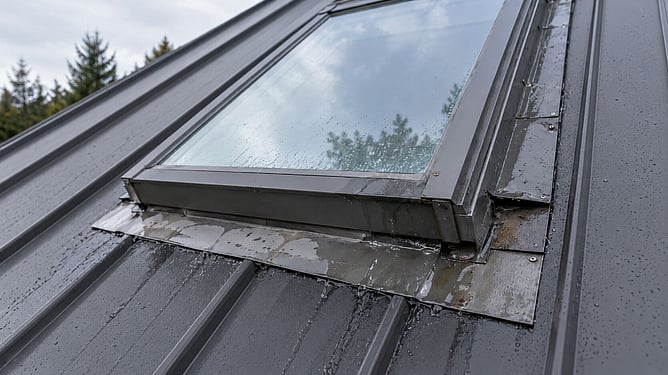
One reason flashing problems can be difficult for homeowners to identify is that the visible leak can be some distance from the actual defect.
Water may enter through a small opening, travel beneath a roofing sheet or along another building element, and only become visible when it reaches a ceiling lining, wall or opening. That can make a chimney, skylight or even an apparently unrelated section of roof look like the problem when the original point of entry is somewhere else.
This is why diagnosing the route the water is taking is so important. Repairing only the location where the water becomes visible can leave the real cause untouched.
7 Warning Signs Your Chimney Flashing May Be Leaking
A leak near a chimney is not always caused by the flashing, but there are several signs that make the flashing and surrounding roof detail worth investigating.
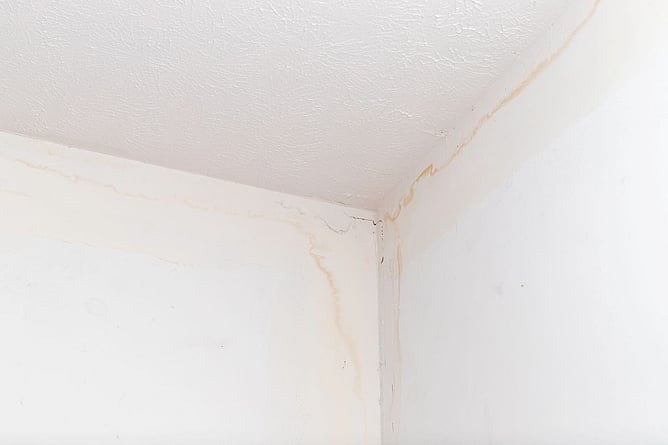
Water staining on ceilings or walls near the chimney is one of the most obvious symptoms. Dampness that appears after heavy or wind-driven rain can also point towards a vulnerable junction around the chimney.
Outside, there may be visible changes to the flashing itself. Metal flashing can lift, distort or corrode over time. Sealants used as part of the detail may deteriorate, and masonry chimneys can develop cracking or crumbling mortar around areas that interact with the roof.
MBIE recommends checking roof cladding, chimneys and flashings annually and specifically identifies corroded or lifted flashings and crumbling chimney mortar as conditions to look out for.
Another useful clue is a leak that appears only during certain weather conditions. If water enters only when rain is being driven from one direction, the weakness may be at a particular lap, edge or junction rather than across the entire chimney flashing.
Why Chimney Leaks Can Appear Only During Wind-Driven Rain
A flashing detail may appear perfectly watertight during light or relatively vertical rainfall but behave differently when strong wind pushes water against the junction.
Wind-driven rain can send water into areas that are rarely exposed during calmer weather. If a flashing has lifted, a lap is inadequate or a previous repair has deteriorated, water may be pushed into the vulnerable part of the detail.
This can explain why some chimney leaks seem inconsistent. A homeowner may see no problem during several rainy days, then suddenly notice staining during a particular storm.
When the Chimney Itself May Also Need Attention
We also need to distinguish between a flashing problem and a problem with the chimney.
Deteriorating mortar, masonry defects, chimney caps and other components can contribute to moisture entry. The roofing around the chimney may also have its own deterioration.
Rather than assuming that every leak beside a chimney requires new flashing, we look at the chimney, the flashing and the surrounding roof together. That gives us a much better chance of identifying what is actually allowing the water in.
Is Your Skylight Really Leaking? 5 Problems That Can Look the Same
When water appears beside or below a skylight, the natural conclusion is often, "My skylight is leaking."
Sometimes it is. In other cases, the skylight unit is still performing properly and the leak is coming from the flashing or surrounding roof.
There are several possible causes that need to be separated before deciding on a repair.
Skylight Glazing or Unit Failure
Water can sometimes enter through a fault in the skylight unit itself. Depending on the type and age of skylight, this may involve the glazing system, frame or another part of the unit.
If the skylight itself has failed, repairing the surrounding roof flashing will not solve that problem.
Condensation Around the Skylight
Not every sign of moisture around a skylight comes from rain.
Skylights can be areas where internal condensation becomes particularly noticeable because of differences in surface temperature and indoor humidity. Moisture forming internally requires a different solution from rainwater entering through the roof.
That distinction is important before any roofing work is recommended.
Ageing Skylight Seals
Seals and gaskets can deteriorate with time. If moisture is entering through part of the skylight assembly, this may look almost identical inside the home to a flashing leak.
Again, the visible location alone does not tell us enough.
Failed or Poorly Detailed Skylight Flashing
The skylight itself may remain completely serviceable while the flashing that connects it to the roof has deteriorated.
Flashing can corrode, lift, move or become damaged. Older installations may also have details that are no longer performing as intended, while later repairs may have relied too heavily on sealant rather than addressing the underlying flashing arrangement.
In these situations, replacing the whole skylight may be unnecessary if the actual problem is the roofing detail around it.
Problems in the Roofing Around the Skylight
The defect may also sit immediately outside the flashing.
Corrosion, damaged roofing, loose or ageing fixings, previous patch repairs or another nearby junction can allow water underneath the roof and towards the skylight opening.
That is why we inspect the wider area rather than looking only at the skylight frame.
Why Roof Flashing Problems Develop Around Bay of Islands Homes
Roof flashing can deteriorate for a range of reasons, and there is rarely one single cause that applies to every property.
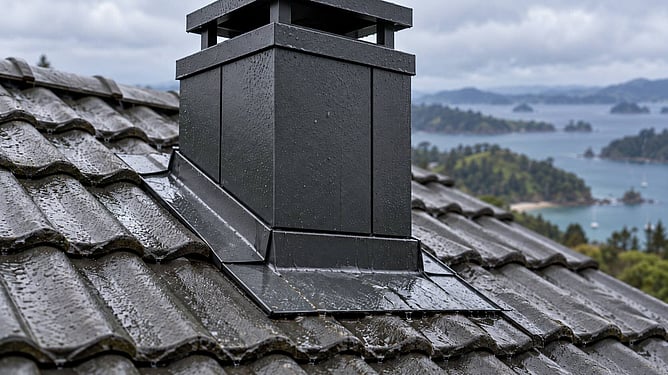
For homes in the Bay of Islands, coastal exposure makes the suitability and corrosion resistance of roofing, flashings and fasteners particularly important. That does not mean every roof near the coast will develop the same problems, but exposure should be considered when materials are selected and when deterioration is assessed.
Current E2/AS1 guidance requires flashing materials to account for the environment where the building is located and notes that exposure zones can affect flashing durability because of wind-driven sea salt.

Coastal Exposure and Corrosion
Corrosion can gradually weaken metal roofing components and become particularly important around detailed junctions.
The condition of a flashing therefore needs to be considered alongside its material, age, coating and exposure. Areas that remain damp, trap contaminants or are not readily washed by rain may also behave differently from open roof surfaces.
For properties exposed to coastal conditions, material suitability should be part of both the original installation and any later roof flashing repairs in the Bay of Islands.
Wind Exposure and Flashing Movement
Wind exposure varies significantly from one property to another.
A sheltered home and a house positioned on a more exposed site can experience very different conditions. Over time, movement or lifting around roofing components can affect laps, fixings and joints, particularly where deterioration is already present.
When we investigate a flashing leak, we therefore look for physical movement as well as corrosion or obvious holes.
Incompatible Roofing and Flashing Materials
The material used for a flashing also needs to be compatible with the surrounding roofing.
Certain materials can react when placed in contact with one another or when water flows from one material onto another. E2/AS1 specifically requires surrounding materials and exposure conditions to be considered when selecting flashings, while New Zealand metal roofing guidance also highlights contact and runoff compatibility.
This becomes particularly relevant when an older roof has received alterations or repairs using different materials.
Ageing Sealants, Fasteners and Previous Repairs
Not every flashing problem begins with the flashing metal itself.
Sealants can deteriorate, fasteners can age and previous patch repairs can eventually lose their effectiveness. A repaired area may also provide clues that the roof has leaked there before.
When we see several generations of sealant or patching around the same penetration, we want to understand why the area has needed repeated attention instead of simply adding another layer.
Can Leaking Roof Flashing Be Repaired or Does It Need Replacing?
This is usually the key question once a flashing problem has been identified.
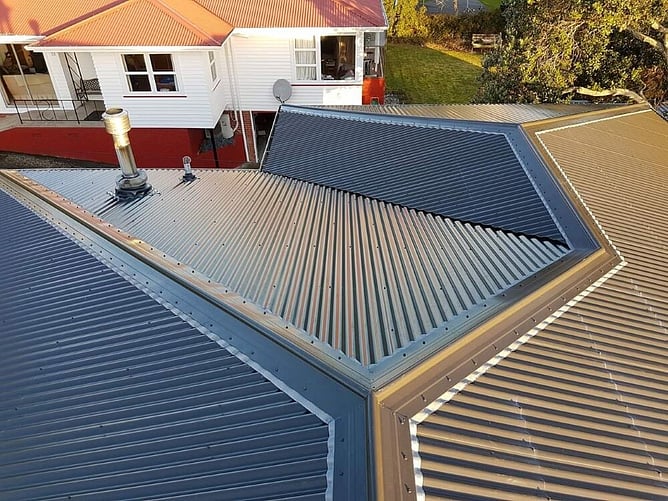
The answer depends on the condition of the flashing, the surrounding roofing and the reason the water is getting in. Some defects can be repaired locally. Others need new flashing, while some leaks point to a wider problem with the roof.
We diagnose the cause first rather than simply applying more sealant to the most obvious gap.
When a Minor Flashing Repair May Be Enough
A local repair may be appropriate when the defect is isolated and the overall flashing and roofing remain sound.
For example, there may be a limited issue with a fixing, sealant detail or small section of the junction that can be corrected without replacing all of the flashing.
The important point is that the rest of the detail needs to be in serviceable condition. A minor repair makes far less sense if the flashing is already extensively corroded, badly formed or repeatedly failing.
When the Flashing Itself Should Be Replaced
Roof replacement may be the better option when the flashing is significantly corroded, damaged, poorly formed, undersized or no longer able to manage water effectively.
We may also recommend replacement when an existing detail has obvious weaknesses that cannot be reliably corrected with another patch.
In those situations, addressing the flashing properly can make more sense than repeatedly repairing individual symptoms.
When the Leak Points to a Wider Roofing Problem
Sometimes the flashing is only part of what we find.
The surrounding roofing may also be deteriorating, fasteners may be failing, underlay may have been affected or another junction may be contributing to the water-entry path.
That is why we avoid deciding on the repair before the roof has been assessed. The most visible defect is not always the only defect.
Why Sealing Over Leaking Flashing Is Not Always a Long-Term Fix
Sealant has legitimate uses in roofing. The problem is not that sealant exists. The problem is expecting a bead of sealant to compensate for a flashing detail that is no longer doing its job.
If a flashing is corroded, moving, poorly formed or incorrectly integrated with the roof, applying more sealant may cover part of the problem without fixing the underlying reason water is reaching that area.
Roof Sealant Has a Job, but It Cannot Correct Poor Flashing Design
A successful flashing detail primarily needs to control the way water moves.
Correct laps, appropriate upstands, suitable materials and integration with the roofing are all part of that process. Sealant may form part of a suitable system, but it should not have to perform the entire job of the flashing.
NZ weathertightness guidance similarly treats individual flashings and cladding sections as parts of a complete system that directs water to the exterior.
Why Repeated Patch Repairs Can Hide the Actual Problem
A patch may stop visible leaking for a period without correcting the original defect.
Water may then find another path, or the same repaired area may reopen as materials move and age. That can lead to another patch, then another, until the underlying flashing detail is buried beneath layers of temporary repairs.
If the same chimney or skylight keeps leaking, it is worth investigating why.
A Proper Repair Starts With Finding the Water-Entry Point
One principle matters throughout this process:
Don't assume the thing that's dripping is the thing that's failed.
The damp patch is evidence. It is not necessarily the source.
Our job is to follow that evidence back towards the likely entry point and repair the roofing detail responsible.
What We Check When Investigating Chimney and Skylight Roof Leaks
When we inspect a chimney or skylight leak, we are trying to understand the complete path that water could be taking.
We start by looking at the surrounding roof condition. That includes roofing sheets or tiles, visible corrosion, damage, fasteners and signs of movement. We also look for old repairs because they can tell us whether the area has caused problems before.
From there, we assess the flashing itself. We look at laps, upstands, edges and the way water is expected to drain around the penetration. We check for corrosion, lifting, distortion, failed sealants and other weaknesses that could allow moisture underneath.
For chimney leaks, we also consider the visible condition of the chimney and mortar. For skylights, we look at the frame, seals and surrounding unit so we can separate an actual skylight problem from a roofing or flashing issue.
Roof pitch and the drainage path are important too. Water coming down the roof needs somewhere safe to go, particularly above a larger penetration.
Finally, we consider where the water is appearing internally and whether that location makes sense in relation to the roof details above it.
This investigation is what allows us to recommend a repair based on the likely cause rather than guesswork.
When Should You Get a Chimney or Skylight Leak Checked?
A chimney or skylight leak is worth investigating when staining returns after rain, dampness appears repeatedly during particular wind conditions or visible flashing has started to lift, corrode or distort.
You should also pay attention to deteriorating chimney mortar, old patch repairs that keep failing, or any situation where you cannot tell whether the water is coming from the skylight, flashing or surrounding roof.
Early investigation can be particularly useful because moisture entry is not always dramatic. A small recurring leak may show up as staining or dampness well before water begins dripping heavily into the room.
MBIE recommends regular inspection of roof cladding, chimneys and flashings as part of building maintenance.
Homeowners should not put themselves at risk by climbing onto a wet, steep or unfamiliar roof to search for the source. A ground-level visual check and noting when and where the leak appears can provide useful information, while the roof itself can be inspected safely by someone equipped for the job.
Need Roof Flashing Repairs in the Bay of Islands?
If water is appearing around a chimney, skylight or another roof penetration, we can inspect the surrounding roofing and flashing to work out where the moisture is actually getting in.
The right solution may be a local repair, replacement flashing or work to the surrounding roofing system. It depends on what has failed and how water is reaching the interior.
At Flood Roofing, we would rather identify the cause first than cover the symptoms with another temporary patch.
If you need roof flashing repairs in the Bay of Islands, get in touch with our team to arrange an assessment. We can inspect the affected area, explain what we find and recommend the roofing work needed to get the junction functioning properly again.
P: 0800 435 663